|
|
Sound
Karate Club, Inc.
|

_________________________________________________
Sound Karate Club!
“The ultimate
aim of karate lies not in victory or defeat, but in the perfection of the
character
of its
participants.” Gichin Funakoshi
Registration for 2025/2026
Registration will
be on Tuesday September 23 from 6:30 PM to 7:30 PM at the McDougall
School Gym, 69 Hwy 124, Parry Sound, ON P2A 2W7.
Regular
classes start Thursday September 25, 2023. Classes are every Tuesday and
Thursday nights, except for holidays.
Click here for a Registration Form in
PDF format.
Class Schedule
The karate year is
divided into three terms. The fall term
is from September until December. The
winter is from January until March. The spring
term is from April until June.
Classes are held at
the McDougall School Gym, 69 Hwy 124, Parry Sound, ON P2A 2W7, on Tuesday and
Thursday nights. Class times will be set
after registration depending on the number of students.
Need more information or have a
question? Click here to contact us.
Policy on cancelled classes
If school buses are
cancelled because of weather karate classes may still be running. If a karate class is cancelled for whatever
reason, we will post the notification on the Sound Karate Club page on FaceBook.
Contents
Introduction &
Background
Our mission is:
Ø To help individuals challenge themselves in order to
reach their full potential
Ø To build positive character, both mentally and
physically.
Ø To strive for continuous improvement.
Ø To respect others and our environment.
Ø To understand and follow the dojo kun;
the five guiding principles of karate.
The end result is a better person, a
better community and a better world.
Shihan (master) Stan Bradley was a 7th
Dan Black Belt in Shotokan karate who dedicated his life to teaching. At the age of fourteen Shihan Bradley began his
life long journey in martial arts with Kancho Takemasa Okuyama. His journeys took him all over the world and
along the way he achieved many successes winning the Ontario Championships
three times in a row, being awarded the “Coach of the Year” by the Karate
Ontario Association, having his students win the Ontario Championships and the
Canadian Championships, plus many more accomplishments.
Shihan Bradley continued to teach right up
until his battle with cancer ended and he passed away at age 47 on
Instructors
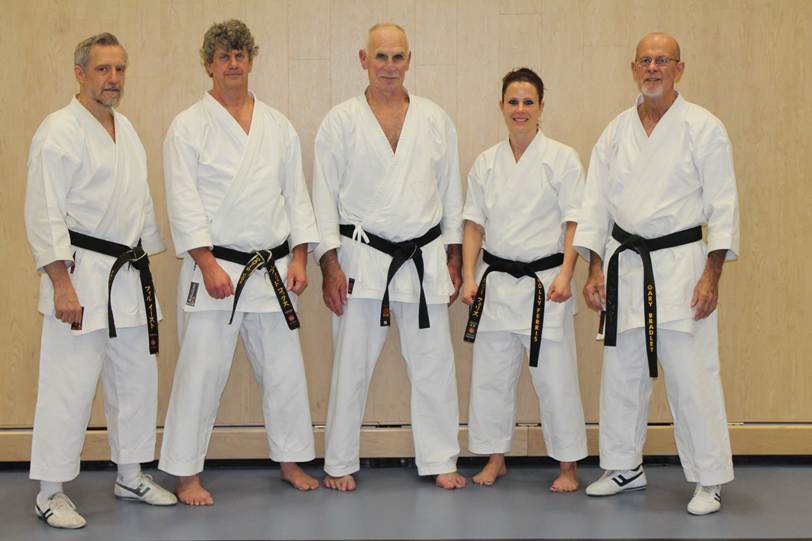
The club today is managed by four
instructors who train under the guidance of Shihan Ted Jungblut. They are Sensei David Cox, Sensei Holly Kelly
and Phil East.
Shihan Ted Jungblut began his Karate
training under Masami Tsuruoka in 1966 and opened the Jungblut School of Karate in 1979. Shihan
Jungblut has represented
Shihan Jungblut’s qualifications include:
ü 8th degree Black Belt in Shotokan Karate
ü 4th degree Black Belt in Chito-Kai Karate
ü 3 time Canadian champion
ü National Team Coach 1985 – 1991
ü Certified by the National Karate and Coaching
Associations of
ü International competitor 1969 – 1978
ü Inducted into the NKA hall of fame 1990
Classes
Classes focus on exercise and self defense using the shotokan
style of karate. Other aspects of
martial arts (such as chito-kai, and other styles) are also part of the
training. Classes typically begin with
stretching and warm-up exercises followed by martial arts training. The classes are divided by age group and
skill level where each student works at their own pace.
Please note that individual students will
progress at different rates. This is
normal. At higher belt levels (green and
above) it can take a year or two before a student progresses
to the next level. Green belts and above
need to attain a level of fitness, agility, focus and self-control, along with
great improvement in the forms of the martial arts before they progress. All of
this takes time to develop. It is
important to practice karate at home so that the moves become second nature to
the student.
It is very important to train regularly unless you are ill!
Regular training enables you to progress. If you are ill, we ask that you
do not train for two reasons: One is that your body needs rest to beat your
ailment, and two; other students do not want to catch your illness.
Parents and guardians: If you are
dropping a child off for karate, you must take your child inside the dojo
(training room) to ensure that classes are running that night. For safety, especially during dark winter
nights, do not drop you child off on the street. When classes have finished, a parent or a
responsible person must be there to pick children up.
If you would like to take pictures during
a class, please ask a sensei first. We
request that you do not take pictures during a test as the interruption
breaks the student’s concentration and disrupts the current session. After the grading has been completed, there
will be time for picture taking. Thank
you in advance!
Club Rules
Common sense and courtesy. If in doubt, ask.
Fees
Fees are collected to cover the cost of
insurance, visiting instructors, incorporation, accounting, equipment
purchases, and general expenses. There
are three sessions; fall (September to December), winter (January to March),
and spring (April to June). Fees are
paid in advance of each session.
Fees are subject to change. The current fees for each session are:
Children beginners (ages 6 to 7): $120 per session
Children/Teenagers/Students: $165 per session
Adults: $175
per session
Session 1: September
to December
Session 2: January
to March
Session 3: April
to June
Dojo Kun
The dojo kun was
written by Gichin Funakoshi and is the ethics of karate. Each is numbered as “one” as they are of
equal importance:
- hitotsu, jinkaku kansei ni tsutomurukoto.
one, to work toward completion/perfection of character.
- hitotsu, makoto no michi wo mamorukoto.
one, to protect the path of truth.
- hitotsu, doryoku no seishin wo yashinaukoto.
one, to nurture a spirit of hard work.
- hitotsu, reigi wo omonzurukoto.
one, to give weight to courtesy and respect.
- hitotsu, kekki no yuu wo imashimurukoto.
one, to rein in impetuousness.
The language is old Japanese and does not translate
well into English. In
- Seek perfection of character.
- Be faithful.
- Endeavour.
- Respect others.
- Refrain from violent behaviour.